
Questions or ideas?
We would love to hear from you!
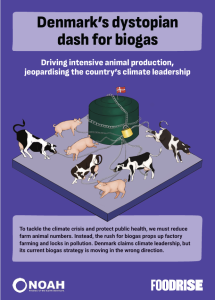
Our new research together with NOAH-Friends of the Earth Denmark, reveals a concerning development: the expansion of manure-fed biogas risks undermining Denmark’s climate ambitions. Analysis of Danish biogas and livestock data shows that, despite an overall reduction trend, municipalities with the largest biogas production capacity have also experienced the greatest increases in pig or cattle numbers over the past 15 years. The four municipalities with the highest biomethane and electricity production saw an estimated 8% increase in pig numbers, while those ranked 5–8 saw a 5% increase in cattle between 2010 and 2024.
That the hype around biomethane is real is also reflected in the European Commission’s ambition to reach 35 billion cubic metres (bcm) per year by 2030. This trend comes at a time when scientists repeatedly stress the need to reduce livestock numbers to meet climate targets. Animal agriculture accounts for an estimated 84% of EU agricultural emissions, and around 80% in Denmark. While the industry promotes biogas as a solution to methane emissions, manure represents only about one-quarter of total emissions from animal production. This narrative overlooks emissions from enteric fermentation (such as methane from ruminant digestion), which account for nearly 40%, as well as emissions from feed production, responsible for around 30%.
Despite these limitations, funding priorities tell a different story: an estimated 20 times more public funding is allocated to biogas than to the Plant-Based Food Grant under Denmark’s Plant-Based Action Plan.
The data also highlights a broader trend of intensification in livestock farming. While the number of pig farms has dropped from over 5,000 in 2010 to fewer than 2,000 in 2024 (a reduction of more than 60%), the average number of pigs per farm has more than doubled, from 2,600 to nearly 6,000.
This points to a key structural issue: scaling up biogas requires large volumes of manure. The industry aims to collect significantly more manure than the government predicts, relying on unrealistically high collection rates of around 75% of the total manure produced. Under more realistic assumptions, meeting these targets would require a substantial increase in livestock numbers—resulting in higher emissions and greater environmental pressure. The benefits of biogas expansion therefore appear to favour mostly large-scale industrial farms, with the potential to lock us into an industrial food system that affects animals, people, and the planet.
Read the full briefing here:

We would love to hear from you!
Share on social media
Stay up to date with our latest work.
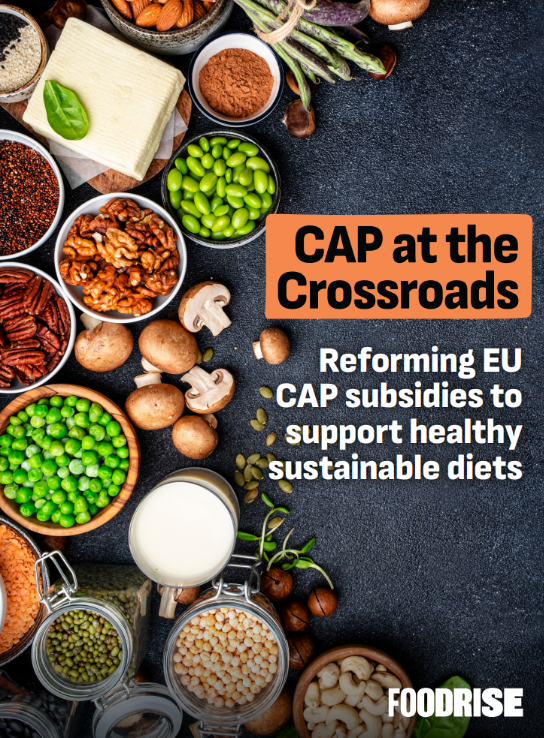
CAP at the Crossroads: Reforming EU CAP subsidies to support healthy sustainable diets, a new report from Foodrise, reveals the scale of EU common agricultural policy (CAP) subsidies directed to meat and dairy, and makes the case for reform to support healthy sustainable diets.
What’s the problem?
Animal-sourced foods are estimated to cause a staggering 81-86% of the total greenhouse gas emissions from EU food production, yet only supply an estimated 32% of calories and 64% of protein consumed in the EU.
This new report reveals that a hugely unfair share of EU CAP subsidies, worth billions of euros of EU taxpayers’ money, are directed to propping up high-emissions meat and dairy production, and to promote meat and dairy products.
The EU is at a crossroads – poised to make crucial decisions on the future of CAP for 2028–2034. Right now, it has the opportunity to support a transition to healthy sustainable diets – a huge economic opportunity with multiple benefits for EU food security, climate mitigation, nature and health. Or continue with a broken status quo.
Key findings:
Solutions
Calls have been growing for agricultural subsidies to be reformed to support a shift to healthy sustainable diets and reduced livestock numbers – including the EU’s Group of Chief Scientific Advisors, the European Court of Auditors, the World Bank, and the 2025 EAT-Lancet Commission.
The benefits this could bring are huge.
The adoption of the plant-rich Planetary Health Diet in high-income countries could reduce agricultural production emissions by an estimated 61%. It could also reduce the EU’s reliance on food imports, boost agricultural incomes, reduce EU fertiliser use by about a quarter, reduce deaths from air pollution, and prevent up to up to 10–39% of cancers in Europe.
Policy recommendations
We recommend that EU policymakers:
What the experts say
Martin Bowman, Senior Policy and Campaigns Manager at Foodrise, said:
“It’s scandalous that such an unfair share of EU subsidies, worth billions of euros of EU taxpayers’ money, are being pumped into propping up high-emissions meat and dairy production and distorting European diets. CAP is at a crossroads, and EU policymakers have a huge opportunity to switch course and take the action required to support a just transition to healthy sustainable plant-rich diets. Which we know have the potential to boost farmer incomes, reduce reliance on imports, mitigate climate change, improve Europeans’ health and restore nature.
“At the very least, plant-based foods deserve a fairer share of CAP subsidies, to compete on an equal footing. In line with the recommendations of the landmark Strategic Dialogue report, EU policymakers should urgently introduce a Plant-Based Action Plan to promote plant-based foods across the supply chain, and an Agri-food Just Transition Fund to support farmers in the transition. The shameful use of EU funds to promote meat and dairy to EU citizens – which is directly contrary to EU health and climate goals – should end immediately.”
Read the full report:
We would love to hear from you!
Share on social media
Stay up to date with our latest work.
For Foodrise, this is an important achievement in our campaigning work over the past couple of years. To have a serious chance of responding to the climate crisis and improving public health, we need to reduce animal numbers and promote plant-based alternatives. The global livestock sector is estimated to be responsible for between 12% and 19% of total human-caused climate emissions, making it one of the world’s highest-emitting sectors. The current industrial scale of meat and dairy production poses a serious threat to both planet and people.
Together with other NGOs, we’ve actively driven the protein agenda, working to steer the Netherlands towards a more plant-based future. We see enormous potential: farmers shifting to plant-based production, consumers discovering new alternatives, and policies aligning with climate goals. The advertising ban brings that future one step closer to reality and helps turning ambition into action.

We would love to hear from you!
Share on social media
Stay up to date with our latest work.
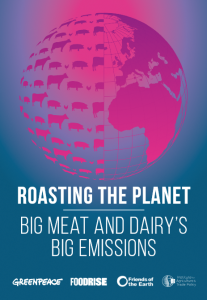
The global livestock sector is estimated to be responsible for between 12% and 19% of total greenhouse gas emissions, according to a recent study from Foodrise, Friends of the Earth, IATP and Greenpeace. The European Union houses more than a third of these industry’s top polluters. When talking about the drivers of the climate crisis, most eyes are focused on fossil fuels, transport, and individual lifestyle choices. And all the while, big corporations like Lactalis (France), Arla (Denmark), Nestlé (Switzerland), and FrieslandCampina (the Netherlands) continue business as usual, without facing any real accountability for their damaging practices.
To have any real chance of limiting global warming to the Paris Agreement’s 1.5°C target, the livestock sector needs to be taken just as seriously as the biggest oil firms. The top five meat and dairy emitters alone produce more greenhouse gas emissions than major oil companies such as Shell. There is no time left for techno-fixes that won’t hold up in court. Livestock reduction is the only credible path forward.
In 2023, the climate emissions of the 45 biggest producers were estimated to exceed the reported emissions of all EU27 countries and the UK combined. This strongly accelerates global warming, fuels extreme weather and environmental destruction, and contributes to air pollution that harms human health.
Read our latest findings here:
We would love to hear from you!
Share on social media
Stay up to date with our latest work.
Learn in less than three minutes about a new, revolutionary supermarket model. It’s not only a place to do your groceries, but also a place that brings people together and offers access to healthy, sustainable food.
The residents of Moerwijk started the initiative and built the foundation for the concept of a ‘democratic supermarket’. Together with them, Foodrise further explored what this concept would entail and how it could make a big difference for the neighbourhood.
Watch the video below in English or Dutch.

Iedereen moet toegang hebben tot gezond en betaalbaar voedsel
See the issue
We would love to hear from you!
Share on social media
Stay up to date with our latest work.
This week marks the European Biomethane Week, a moment when producers, users, investors, and legislators come together to further boost the ongoing upscaling of biomethane. And, of course, it’s also the moment for Foodrise to be a critical voice in the room.
Since we started working on this topic in 2020, we have seen it all: the potential, the room for improvement, but above all the concerning pathway that currently planned biomethane upscaling could lead us down, one where we risk locking ourselves into a dependency on large-scale animal production for both our food and our energy. This, at a time when, both from a climate and dietary perspective, we should actually be moving towards more plant-based food production.
But there is more. Together with the StopTheBiomethaneRush Coalition, we have highlighted multiple downsides of the biomethane rush: impacts on local communities, methane leaks, dependency on food waste instead of preventing it, and many others.
In other words, we simply can’t sit still during this week, and we won’t.
Today, the Methane Matters Coalition – consisting of Changing Markets, Deutsche Umwelthilfe, EEB, Zero Waste Europe and the Environmental Investigation Agency – has launched its new comprehensive report, undertaken by Profundo: “Biogas in the EU: A policy and financial analysis”, for which we have been happy to provide input on this journey as part of the study’s steering committee; and also be part of a panel at its launch event.
The goal of the research has been to provide a concrete analysis of the policy and financial environment for biogas, the potential risks associated with this, and any recommendations for how policies and financial flows can be changed to build a more sustainable and just energy transition in Europe. For this, the report also includes case studies from seven European countries – six EU member states, Denmark, Germany, Ireland, the Netherlands, Poland, and Romania, chosen to reflect a balance of geographies within the EU, and the UK.
Some key insights from the report:
Since our organisation is based in the Netherlands, we were particularly interested in taking a closer look at the current state of biomethane here. The report provides excellent insights with a dedicated Dutch case study:
As highlighted in the report, the biomethane industry in the Netherlands is still in its early stages, now spurred by the country’s new target of 2 billion cubic metres by 2030. This makes it especially important to avoid the pitfalls experienced in other EU countries and to ensure that biomethane develops within a sustainable niche.
The report therefore includes the following recommendations to Dutch policymakers:
Introduce a moratorium on biomethane from manure sourced from industrial animal farming
While the expansion of biomethane production in the Netherlands is still in its early stages, the government’s intention to significantly increase production by using large quantities of animal manure contrasts sharply with the country’s dramatic nitrogen crisis and the need to significantly and rapidly reduce livestock numbers. Dutch policy-makers must review biomethane policies and subsidies as laid out in this research, stop any incentives that could lock in industrial animal farming, and ensure that biomethane policies are co-designed and coherent with efforts to reduce the number of animals.
Maintain stringent MER-requirements for biogas production facilities and distribution channels in allocating so-called ‘’acceleration areas” under RED III
The Netherlands should maintain a so-called Project-MER (i.e. a project-based environmental impact assessment) requirement for biogas production facilities and distribution channels. While the Dutch government is in the process of identifying so-called ‘’acceleration areas’’ for the Dutch energy transition as part of its transposition of RED III into national law, regulators must ensure that environmental safeguards for biogas production facilities and distribution channels are maintained.
Respect the EU-wide nitrogen application levels for animal manure and oppose the RENURE changes to the Nitrates Directive
Contrary to recent actions, the Dutch government should oppose changes in the EU Council to increase the maximum nitrogen application level and to stop applying for any future derogations under the existing limits. The Netherlands is one of three European countries that have a derogation under the EU Nitrates Directive, allowing some farmers to apply more nitrogen from animal manure per hectare. In 2024, the EU Commission opened a public consultation on revising Annex III of the Nitrates Directive, aiming to increase the maximum nitrogen application level from 170 kg to 270 kg per hectare, provided that this nitrogen originates from ‘recovered nitrogen from manure (RENURE)’ fertilisers.
More information can be found on the Methane Matters Coalition page: https://methanematters.eu/
We would love to hear from you!
Share on social media
Stay up to date with our latest work.
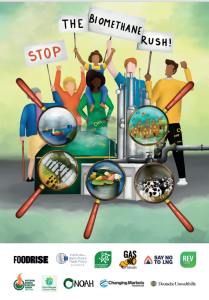
After months of hard work, it is finally here: our StopTheBiomethaneRush booklet!
This is not only a big moment for us at Foodrise after five years of working on this topic – it is especially so for our StopTheBiomethaneRush coalition.
From a small group of organisations that would informally discuss biomethane, we have evolved into a strong coalition ready to step up at a time when biomethane is heavily promoted as “the” sustainable solution – be it for the agricultural sector, industry, transport, or the energy system as a whole.
But where there are glossy brochures and European production targets being set based on industry calculations, it’s important to take a closer look. We do so with StopTheBiomethaneRush, a diverse coalition of organisations active in the fields of food sovereignty, sustainable land use, animal rights, energy systems, shipping, the heating transition, and emissions mitigation. Importantly, local communities around Europe are also represented in our coalition, giving voice to those directly affected on the ground. Together, we challenge the large-scale development of industrial biogas operations, which create risks of additional environmental pollution, climate impacts, animal cruelty, and social injustices.
Don’t get us wrong. As a coalition, we do recognise that biomethane from unavoidable organic waste streams can contribute to energy needs. But production levels must be kept within a sustainable niche.
What does that mean specifically? We explain it in our new StopTheBiomethaneRush booklet. Our analysis, based on scientific evidence and the experiences of impacted communities, identifies how policy can ensure biomethane production remains compatible with sustainable practices in the farming, food, and energy sectors, while also respecting community well-being.
With Denmark, a major producer of biomethane linked to its highly industrialised animal production system, having taken over the EU Presidency at the beginning of July, we look forward to contributing our expertise over the next six months and beyond.
Let’s get this right!
Read the booklet here:
We would love to hear from you!
Share on social media
Stay up to date with our latest work.
On 16 June 2025, a day before the start of the Healthy Food Healthy Planet Annual Forum in Serock, Poland, the Food Voices Coalition came together to reflect on where we stand and how to take our next steps. ALTAA, Cecu, Foodrise UK and Foodrise EU, Green REV Institute and Terra! engaged in discussions on how to shape the Menu of Food Voices, a document that we are preparing to share our experiences on how we contribute to food system transformation by listening to people’s voices.
 During the Annual Forum, which had power as the central theme (power over, to, with and within), we shared already some of our experiences through the ladder & snakes’ game of power. The game was designed by Lucy Antal from Foodrise UK with contributions from the other organisations. There were four groups each representing a character, in this case a young activist, consumer, corporate power and policy maker, each with their own symbol on the pawns. There were several extra features, such as certain advantages or disadvantages you have as a character related to power, or squares like “drought” that led you backwards on the board. If you had landed on one of the colored squares of the giant game board after throwing a die, a realistic scenario was presented, in which you had the choice between two options. The decision had to be taken from the perspective of the character and after consultation in the group about the scenario. It was a successful try-out with many positive reactions.
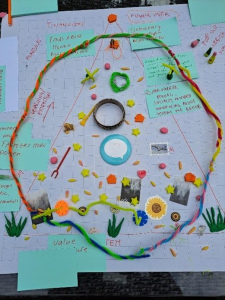 Located in a beautiful, forested area, the Annual Forum provided ample opportunities to connect with each other. The program was designed to connect with and use the wisdom of our bodies. We let our hands do the talking in depicting a European food system (both the current and the ideal system). We could immerse ourselves in the world of unusual allies and create messages to connect with them. We could also take a nap together (‘rest is resistance’) or meditate, alongside storytelling and workshop sessions to develop our skills. This way of connecting creates a completely new dynamic of interaction.
The creative approach, the environment, and the many inspiring people made it a truly powerful meeting. By approaching the huge task of transforming the unjust and harmful food system not only rationally with our brains but by using emotions and intuition and body wisdom, new insights are born and we can be more effective in having an impact. Understanding at an emotional level how power affects us and our relationships and our work opens new ways of working. Before we can change the system we have to be aware of the system within ourselves!

Iedereen moet toegang hebben tot gezond en betaalbaar voedsel
See the issueWe would love to hear from you!
Share on social media
Stay up to date with our latest work.