
Questions or ideas?
We would love to hear from you!
This week more than 800 biogas producers, farmers’ lobbyists, energy executives, investors and politicians gather in Brussels for the European Biomethane Week. For the past years, we’ve been campaiging against biogas expansion: While it can support the energy transition on a small scale, it risks locking in industrial farming. Here are our main remarks:
Under the theme “Made in Europe” the organizers are pitching biomethane as the cornerstone of EU energy independence — a message the EU’s Energy Commissioner will endorse with an opening keynote. Planned investment in biogas has jumped to €36 billion, up 28% in a single year. More growth is expected with the EU’s goal of producing 35 billion cubic metres (bcm) of biomethane a year by 2030 — well over the 5 bcm produced last year.
Gas from sewage sludge and unavoidable organic waste, tightly regulated and used where nothing better exists, can cut emissions somewhat. But that is not what this boom is about. The majority will be invested into the plants that extract methane from Europe’s cattle and pig manure — a feedstock the industry expects to supply a third of EU biomethane by 2030.
Denmark shows the risks involved. Our research, together with NOAH-Friends of the Earth Denmark, found that pig numbers rose 8% between 2010 and 2024 in the four municipalities with the most biogas plants, while the national herd shrank. Farms in these areas halved in number and doubled in size. Meeting Denmark’s 2030 biogas target will require 94% of today’s pigs and cattle to still be around.
Nor is this “Made in Europe”. Europe’s livestock runs on imported feed: soy and maize from the Americas, grown with fertiliser made from imported gas. The EU uses an area abroad the size of the Benelux plus Denmark just to grow soy for its animals. And over 70% of farmland at home feeds livestock instead of people.
Public money can be spent only once. Every euro sunk into manure infrastructure is a euro not spent on wind, solar, insulation, or farmers switching to more sustainable land-based agriculture. On a small scale, biomethane can support the energy transition. But the boom that’s celebrated at European Biomethane Week risks becoming a subsidy for factory farming.

We would love to hear from you!
Share on social media
Stay up to date with our latest work.
On September 7th, the Dutch government will debate the requirement of adding more green gas to the gas supply. This may sound sustainable, but it is not. More than a third of that green gas must come from manure. As a consequence, this climate measure threatens to become an investment in intensive livestock farming. On behalf of a coalition of sixteen nature, farmers’, and animal welfare organisations, we warn the government against wasting public funds on unsustainable food production.
Biogas is produced through manure fermentation. The Dutch government believes this is a solution for the transition to green gas. We agree that we should stop depending on fossil gases and we know that biogas can play a role in this. But large-scale manure fermentation is not the solution. If we start using biogas as a serious energy source, we will lock-in the industrial livestock industry. We’ll keep depending on manure as an energy source, whereas for years, climate scientists have been saying that livestock numbers must shrink if we want to reduce emissions.
Public money can only be spent once. Every euro spent on manure infrastructure is one that does not go to solar and wind, to insulation, to green gas from truly renewable sources such as sewege sludge – or to the farmers who want to make the swith to land-based agriculture.
Read the letter here, in Dutch.
We would love to hear from you!
Share on social media
Stay up to date with our latest work.
Today, Ireland took over the Presidency of the Council of the EU. Together with farmers’ groups, civil society organisations and community groups, we sent an open letter urging the new Presidency to rethink the EU’s and Ireland’s current approach to biomethane expansion.
We warn that expanding biomethane production risks locking Europe into polluting industrial livestock farming, undermining efforts to reduce livestock numbers and build a more sustainable and resilient food system. Rural communities are being asked to carry an unfair share of the environmental, social and infrastructural burden, while the benefits often flow elsewhere. Through this open letter, we aim to ensure that these concerns are part of the conversation as the EU shapes its future energy and agriculture policies.
Europe needs to transition away from fossil fuels and environmentally destructive industrial systems. The current trajectory of industrial biomethane will not deliver that transition. We need to change course.
Click here to read the full letter.
Signed by:
We would love to hear from you!
Share on social media
Stay up to date with our latest work.
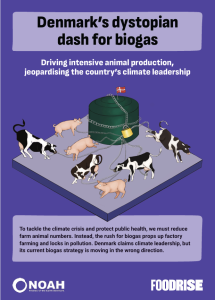
Our new research together with NOAH-Friends of the Earth Denmark, reveals a concerning development: the expansion of manure-fed biogas risks undermining Denmark’s climate ambitions. Analysis of Danish biogas and livestock data shows that, despite an overall reduction trend, municipalities with the largest biogas production capacity have also experienced the greatest increases in pig or cattle numbers over the past 15 years. The four municipalities with the highest biomethane and electricity production saw an estimated 8% increase in pig numbers, while those ranked 5–8 saw a 5% increase in cattle between 2010 and 2024.
That the hype around biomethane is real is also reflected in the European Commission’s ambition to reach 35 billion cubic metres (bcm) per year by 2030. This trend comes at a time when scientists repeatedly stress the need to reduce livestock numbers to meet climate targets. Animal agriculture accounts for an estimated 84% of EU agricultural emissions, and around 80% in Denmark. While the industry promotes biogas as a solution to methane emissions, manure represents only about one-quarter of total emissions from animal production. This narrative overlooks emissions from enteric fermentation (such as methane from ruminant digestion), which account for nearly 40%, as well as emissions from feed production, responsible for around 30%.
Despite these limitations, funding priorities tell a different story: an estimated 20 times more public funding is allocated to biogas than to the Plant-Based Food Grant under Denmark’s Plant-Based Action Plan.
The data also highlights a broader trend of intensification in livestock farming. While the number of pig farms has dropped from over 5,000 in 2010 to fewer than 2,000 in 2024 (a reduction of more than 60%), the average number of pigs per farm has more than doubled, from 2,600 to nearly 6,000.
This points to a key structural issue: scaling up biogas requires large volumes of manure. The industry aims to collect significantly more manure than the government predicts, relying on unrealistically high collection rates of around 75% of the total manure produced. Under more realistic assumptions, meeting these targets would require a substantial increase in livestock numbers—resulting in higher emissions and greater environmental pressure. The benefits of biogas expansion therefore appear to favour mostly large-scale industrial farms, with the potential to lock us into an industrial food system that affects animals, people, and the planet.
Read the full briefing here:
We would love to hear from you!
Share on social media
Stay up to date with our latest work.
High-emissions beef and lamb received an estimated 580 times more common agricultural policy (CAP) subsidies from the European Union than legumes such as lentils and beans in 2020 (€8 billion compared to just €14 million), according to shocking figures released by the environmental organisation Foodrise.
Similarly, dairy received an estimated 500 times more CAP payments than nuts and seeds (€16 billion compared to just €29 million). Overall, the EU directed three times more CAP subsidies to production of high-emitting meat and dairy than to plant-based foods in 2020 – around 77% of total CAP subsidies for farmers (€39 billion out of €51 billion).
The breakdown of funding for individual food types by the EU is published today in a new report, CAP at the Crossroads, from the environmental organisation Foodrise showing the production of meat and dairy received over 10 times more CAP subsidies than fruit and vegetable production, and over 16 times more than cereal production.
This comes as EU policymakers are due to make crucial decisions this year on public money given to farmers through its common agricultural policy for 2028–2034, with the significant risk that meat and dairy will continue to get the lion’s share.
These disparities come despite animal-based foods being estimated to cause between 81 and 86% of the embodied greenhouse gas emissions (the total emissions released during the lifecycle of products) from EU food production, [1] while only providing an estimated 32% of calories and 64% of protein consumed in the EU. [2]
On average, beef causes an estimated 21-62 times more emissions compared with pulses, per gram of protein [3] – and pulses have benefits for fixing nitrogen in soils and health. [4]
Calls have been growing for agricultural subsidies to be reformed to support a shift to healthy sustainable diets and reduced livestock numbers – including the EU’s Group of Chief Scientific Advisors, [5] the European Court of Auditors, [6] the World Bank, [7] and the 2025 EAT-Lancet Commission. [8]
But this comes in a context of the EU rolling back environmental commitments faced by agribusiness lobbying and the rise of the far-right – and is still mulling a potential ‘veggie burger’ labelling ban reserving words like ‘burger’ and ‘sausage’ for meat products.
Martin Bowman, Senior Campaigns Manager at Foodrise, said:
“It’s scandalous that such an unfair share of EU subsidies, worth billions of euros of EU taxpayers’ money, are being pumped into propping up high-emissions meat and dairy production and distorting European diets. CAP is at a crossroads, and EU policymakers have a huge opportunity to switch course and take the action required to support a just transition to healthy sustainable plant-rich diets. Which we know have the potential to boost farmer incomes, reduce reliance on imports, mitigate climate change, improve Europeans’ health and restore nature.
“At the very least, plant-based foods deserve a fairer share of CAP subsidies, to compete on an equal footing. In line with the recommendations of the landmark Strategic Dialogue report, EU policymakers should urgently introduce a Plant-Based Action Plan to promote plant-based foods across the supply chain, and an Agri-food Just Transition Fund to support farmers in the transition. The shameful use of EU funds to promote meat and dairy to EU citizens – which is directly contrary to EU health and climate goals – should end immediately.”
The food experts highlight the economic, health and environmental benefits of the EU supporting a shift to healthy sustainable diets – with a greater transition to plant-based foods, and less meat and dairy.
In addition to a move from funding from meat and dairy to plants, Foodrise’s report recommends that the EU takes forward key Strategic Dialogue recommendations, like implementing a Plant-Based Action Plan to promote plant-based foods across the supply chain, and an Agri-food Just Transition Fund to support farmers through a just transition.
The report also recommends ending the use of EU funds for the promotion and marketing of meat and dairy.
The adoption of the healthy sustainable Planetary Health Diet in high-income countries could reduce agricultural production emissions by an estimated 61%. [9] It could also reduce the EU’s reliance on food imports, [10] boost agricultural incomes, [11] reduce EU fertiliser use by about a quarter, [12] reduce deaths from air pollution, [13] and prevent up to up to 10–39% of cancers in Europe. [14]
The European Plant-Based Food and Beverage Market is projected to grow by over 50% to USD 83.3 billion by 2030, [15] and a recent report found that alternative proteins have potential to support 414,000 high-quality jobs by 2040. [16] Healthy sustainable diets could increase average EU agricultural incomes, according to a recent study. [17]
The 2024 Strategic Dialogue on the Future of EU Agriculture resulted in a breakthrough agreement between EU farming groups, civil society, businesses and academics, which acknowledged an EU trend towards more plant-based foods and recommended “it is crucial to support this trend”. [18]
ENDS
Notes to Editors
Methodology
Foodrise analysis was based on the underlying dataset from Kortleve et al (2025), shared by researchers at the University of Leiden. Figures are calculated on a consumption basis – so subsidies for crops fed to animals are counted towards animal sourced-foods. For instance, estimates for subsidies to beef and lamb includes estimated subsidies to animal feed used to produce beef and lamb.
Further info on meat and dairy subsidies
Promotion and marketing of European agricultural products is part of the CAP. Between 2016–2020, the EU spent €252.4 million to exclusively promote European meat and dairy products, including campaigns like “Become a Beefatarian” [19]. In 2023 alone, the EU spent nearly €75 million promoting animal products, of which €29 million was for campaigns encouraging people to eat more meat. [20]
Footnotes
[1] Based on various sources: Anniek J. Kortleve et al., ‘Over 80% of the European Union’s Common Agricultural Policy Supports Emissions-Intensive Animal Products’, Nature Food 5, no. 4 (2024): 288–92, https://doi.org/10.1038/s43016-024-00949-4; Directorate-General for Agriculture and Rural Development (European Commission) et al., Future of EU Livestock: How to Contribute to a Sustainable Agricultural Sector ? : Final Report (Publications Office of the European Union, 2020), https://data.europa.eu/doi/10.2762/3440; European Court of Auditors, Common Agricultural Policy and Climate: Half of EU Climate Spending but Farm Emissions Are Not Decreasing (European Court of Auditors, 2021), 28, https://www.eca.europa.eu/lists/ecadocuments/sr21_16/sr_cap-and-climate_en.pdf.
[2] EC, EU Agricultural Outlook, 2024-2035 (European Commission, DG Agriculture and Rural Development, 2024), 18, https://data.europa.eu/doi/10.2762/2329210.
[3] Joseph Poore and Thomas Nemecek, ‘Reducing Food’s Environmental Impacts through Producers and Consumers’, Science 360, no. 6392 (2018): 987–92, https://doi.org/10.1126/science.aaq0216.
[4] Fabio Stagnari et al., ‘Multiple Benefits of Legumes for Agriculture Sustainability: An Overview’, Chemical and Biological Technologies in Agriculture 4, no. 1 (2017): 2, https://doi.org/10.1186/s40538-016-0085-1.
[5] Directorate-General for Research and Innovation (European Commission) and Group of Chief Scientific Advisors (European Commission), Towards Sustainable Food Consumption: Promoting Healthy, Affordable and Sustainable Food Consumption Choices (Publications Office of the European Union, 2023), 29, https://data.europa.eu/doi/10.2777/29369.
[6] European Court of Auditors, Common Agricultural Policy and Climate: Half of EU Climate Spending but Farm Emissions Are Not Decreasing (European Court of Auditors, 2021), 28, https://www.eca.europa.eu/lists/ecadocuments/sr21_16/sr_cap-and-climate_en.pdf.
[7] The World Bank, ‘Recipe for a Livable Planet: Achieving Net Zero Emissions in the Agrifood System’, World Bank, 2024, xxiii, https://www.worldbank.org/en/topic/agriculture/publication/recipe-for-livable-planet.
[8] Johan Rockström et al., ‘The EAT–Lancet Commission on Healthy, Sustainable, and Just Food Systems’, The Lancet 406, no. 10512 (2025): 1625–700, https://doi.org/10.1016/S0140-6736(25)01201-2; EAT-Lancet Commission, ‘New Landmark EAT-Lancet Commission Warns Food Systems Breach Planetary Limits’, EAT, 2025, https://eatforum.org/update/eat-lancet-commission-warns-food-systems-breach-planetary-limits/.
[9] Zhongxiao Sun et al., ‘Dietary Change in High-Income Nations Alone Can Lead to Substantial Double Climate Dividend’, Nature Food 3, no. 1 (2022): 1, https://doi.org/10.1038/s43016-021-00431-5.
[10] Zhongxiao Sun et al., ‘Adoption of Plant-Based Diets across Europe Can Improve Food Resilience against the Russia–Ukraine Conflict’, Nature Food 3, no. 11 (2022): 11, https://doi.org/10.1038/s43016-022-00634-4.
[11] Jörg Rieger et al., ‘From Fork to Farm: Impacts of More Sustainable Diets in the EU-27 on the Agricultural Sector’, Journal of Agricultural Economics n/a, no. n/a (2023), https://doi.org/10.1111/1477-9552.12530.
[12] Zhongxiao Sun et al., ‘Adoption of Plant-Based Diets across Europe Can Improve Food Resilience against the Russia–Ukraine Conflict’, Nature Food 3, no. 11 (2022): 11, https://doi.org/10.1038/s43016-022-00634-4.
[13] Marco Springmann et al., ‘The Global and Regional Air Quality Impacts of Dietary Change’, Nature Communications 14, no. 1 (2023): 1, https://doi.org/10.1038/s41467-023-41789-3.
[14] In a 20-year risk period. See: Jessica E. Laine et al., ‘Co-Benefits from Sustainable Dietary Shifts for Population and Environmental Health: An Assessment from a Large European Cohort Study’, The Lancet Planetary Health 5, no. 11 (2021): e786–96, https://doi.org/10.1016/S2542-5196(21)00250-3.
[15] Mordor Intelligence, ‘Europe Plant-Based Food and Beverages Market – Size, Trends & Share’, Mordor Intelligence, 11 November 2025, https://www.mordorintelligence.com/industry-reports/europe-plant-based-food-and-beverage-market.
[16] Systemiq, ‘Seizing the Economic Opportunity of Alternative Proteins in Europe’, SYSTEMIQ, January 2026, https://www.systemiq.earth/economic-opportunity-of-alternative-proteins-europe/.
[17] Jörg Rieger et al., ‘From Fork to Farm: Impacts of More Sustainable Diets in the EU-27 on the Agricultural Sector’, Journal of Agricultural Economics n/a, no. n/a (2023), https://doi.org/10.1111/1477-9552.12530.
[18] Strategic Dialogue on the Future of EU Agriculture: A Shared Prospect for Farming and Food in Europe (2024), 10, https://agriculture.ec.europa.eu/document/download/171329ff-0f50-4fa5-946f-aea11032172e_en?filename=strategic-dialogue-report-2024_en.pdf. 11–12.
[19] Greenpeace EU, Marketing Meat: How EU Promotional Funds Favor Meat and Dairy (Greenpeace EU, 2021), https://www.greenpeace.org/static/planet4-eu-unit-stateless/2021/04/20210408-Greenpeace-report-Marketing-Meat.pdf.
[20] Party for the Animals, ‘EU spends millions in taxpayer money on meat ads’, Party for the Animals, 30 April 2024, https://www.partyfortheanimals.com/sv/eu-spends-millions-in-taxpayer-money-on-meat-ads.

We would love to hear from you!
Share on social media
Stay up to date with our latest work.
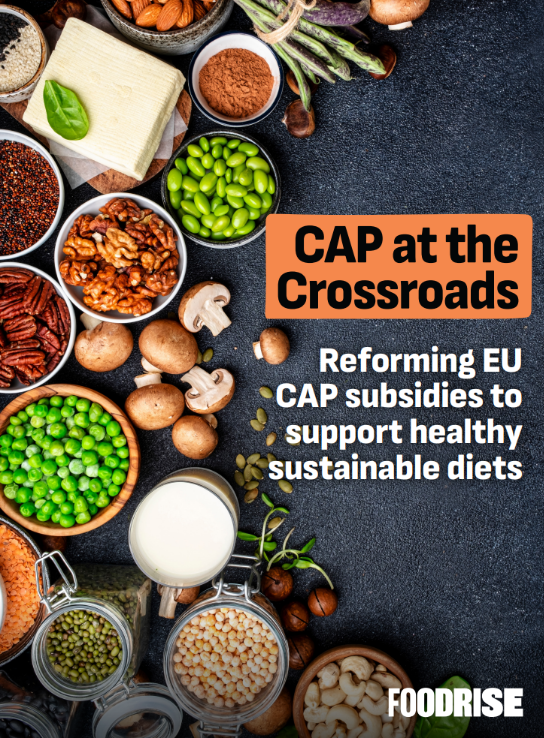
CAP at the Crossroads: Reforming EU CAP subsidies to support healthy sustainable diets, a new report from Foodrise, reveals the scale of EU common agricultural policy (CAP) subsidies directed to meat and dairy, and makes the case for reform to support healthy sustainable diets.
What’s the problem?
Animal-sourced foods are estimated to cause a staggering 81-86% of the total greenhouse gas emissions from EU food production, yet only supply an estimated 32% of calories and 64% of protein consumed in the EU.
This new report reveals that a hugely unfair share of EU CAP subsidies, worth billions of euros of EU taxpayers’ money, are directed to propping up high-emissions meat and dairy production, and to promote meat and dairy products.
The EU is at a crossroads – poised to make crucial decisions on the future of CAP for 2028–2034. Right now, it has the opportunity to support a transition to healthy sustainable diets – a huge economic opportunity with multiple benefits for EU food security, climate mitigation, nature and health. Or continue with a broken status quo.
Key findings:
Solutions
Calls have been growing for agricultural subsidies to be reformed to support a shift to healthy sustainable diets and reduced livestock numbers – including the EU’s Group of Chief Scientific Advisors, the European Court of Auditors, the World Bank, and the 2025 EAT-Lancet Commission.
The benefits this could bring are huge.
The adoption of the plant-rich Planetary Health Diet in high-income countries could reduce agricultural production emissions by an estimated 61%. It could also reduce the EU’s reliance on food imports, boost agricultural incomes, reduce EU fertiliser use by about a quarter, reduce deaths from air pollution, and prevent up to up to 10–39% of cancers in Europe.
Policy recommendations
We recommend that EU policymakers:
What the experts say
Martin Bowman, Senior Policy and Campaigns Manager at Foodrise, said:
“It’s scandalous that such an unfair share of EU subsidies, worth billions of euros of EU taxpayers’ money, are being pumped into propping up high-emissions meat and dairy production and distorting European diets. CAP is at a crossroads, and EU policymakers have a huge opportunity to switch course and take the action required to support a just transition to healthy sustainable plant-rich diets. Which we know have the potential to boost farmer incomes, reduce reliance on imports, mitigate climate change, improve Europeans’ health and restore nature.
“At the very least, plant-based foods deserve a fairer share of CAP subsidies, to compete on an equal footing. In line with the recommendations of the landmark Strategic Dialogue report, EU policymakers should urgently introduce a Plant-Based Action Plan to promote plant-based foods across the supply chain, and an Agri-food Just Transition Fund to support farmers in the transition. The shameful use of EU funds to promote meat and dairy to EU citizens – which is directly contrary to EU health and climate goals – should end immediately.”
Read the full report:
We would love to hear from you!
Share on social media
Stay up to date with our latest work.
From May 2026 onwards, ads featuring burgers, chicken wings, and beef will no longer be visible on the streets of Amsterdam. With this major decision, Amsterdam becomes the first capital city in the world to introduce such a regulation in order to promote more plant-based diets and help tackle the climate crisis. Because how can we stop the polluting practices of the livestock industry if we continue to normalise them through advertisements at the bus stop?
For Foodrise, this is an important achievement in our campaigning work over the past couple of years. To have a serious chance of responding to the climate crisis and improving public health, we need to reduce animal numbers and promote plant-based alternatives. The global livestock sector is estimated to be responsible for between 12% and 19% of total human-caused climate emissions, making it one of the world’s highest-emitting sectors. The current industrial scale of meat and dairy production poses a serious threat to both planet and people.
Together with other NGOs, we’ve actively driven the protein agenda, working to steer the Netherlands towards a more plant-based future. We see enormous potential: farmers shifting to plant-based production, consumers discovering new alternatives, and policies aligning with climate goals. The advertising ban brings that future one step closer to reality and helps turning ambition into action.
We would love to hear from you!
Share on social media
Stay up to date with our latest work.
The global livestock sector is estimated to be responsible for between 12% and 19% of total greenhouse gas emissions, according to a recent study from Foodrise, Friends of the Earth, IATP and Greenpeace. The European Union houses more than a third of these industry’s top polluters. When talking about the drivers of the climate crisis, most eyes are focused on fossil fuels, transport, and individual lifestyle choices. And all the while, big corporations like Lactalis (France), Arla (Denmark), Nestlé (Switzerland), and FrieslandCampina (the Netherlands) continue business as usual, without facing any real accountability for their damaging practices.
To have any real chance of limiting global warming to the Paris Agreement’s 1.5°C target, the livestock sector needs to be taken just as seriously as the biggest oil firms. The top five meat and dairy emitters alone produce more greenhouse gas emissions than major oil companies such as Shell. There is no time left for techno-fixes that won’t hold up in court. Livestock reduction is the only credible path forward.
In 2023, the climate emissions of the 45 biggest producers were estimated to exceed the reported emissions of all EU27 countries and the UK combined. This strongly accelerates global warming, fuels extreme weather and environmental destruction, and contributes to air pollution that harms human health.
Read our latest findings here:
We would love to hear from you!
Share on social media
Stay up to date with our latest work.
This week marks the European Biomethane Week, a moment when producers, users, investors, and legislators come together to further boost the ongoing upscaling of biomethane. And, of course, it’s also the moment for Foodrise to be a critical voice in the room.
Since we started working on this topic in 2020, we have seen it all: the potential, the room for improvement, but above all the concerning pathway that currently planned biomethane upscaling could lead us down, one where we risk locking ourselves into a dependency on large-scale animal production for both our food and our energy. This, at a time when, both from a climate and dietary perspective, we should actually be moving towards more plant-based food production.
But there is more. Together with the StopTheBiomethaneRush Coalition, we have highlighted multiple downsides of the biomethane rush: impacts on local communities, methane leaks, dependency on food waste instead of preventing it, and many others.
In other words, we simply can’t sit still during this week, and we won’t.
Today, the Methane Matters Coalition – consisting of Changing Markets, Deutsche Umwelthilfe, EEB, Zero Waste Europe and the Environmental Investigation Agency – has launched its new comprehensive report, undertaken by Profundo: “Biogas in the EU: A policy and financial analysis”, for which we have been happy to provide input on this journey as part of the study’s steering committee; and also be part of a panel at its launch event.
The goal of the research has been to provide a concrete analysis of the policy and financial environment for biogas, the potential risks associated with this, and any recommendations for how policies and financial flows can be changed to build a more sustainable and just energy transition in Europe. For this, the report also includes case studies from seven European countries – six EU member states, Denmark, Germany, Ireland, the Netherlands, Poland, and Romania, chosen to reflect a balance of geographies within the EU, and the UK.
Some key insights from the report:
Since our organisation is based in the Netherlands, we were particularly interested in taking a closer look at the current state of biomethane here. The report provides excellent insights with a dedicated Dutch case study:
As highlighted in the report, the biomethane industry in the Netherlands is still in its early stages, now spurred by the country’s new target of 2 billion cubic metres by 2030. This makes it especially important to avoid the pitfalls experienced in other EU countries and to ensure that biomethane develops within a sustainable niche.
The report therefore includes the following recommendations to Dutch policymakers:
Introduce a moratorium on biomethane from manure sourced from industrial animal farming
While the expansion of biomethane production in the Netherlands is still in its early stages, the government’s intention to significantly increase production by using large quantities of animal manure contrasts sharply with the country’s dramatic nitrogen crisis and the need to significantly and rapidly reduce livestock numbers. Dutch policy-makers must review biomethane policies and subsidies as laid out in this research, stop any incentives that could lock in industrial animal farming, and ensure that biomethane policies are co-designed and coherent with efforts to reduce the number of animals.
Maintain stringent MER-requirements for biogas production facilities and distribution channels in allocating so-called ‘’acceleration areas” under RED III
The Netherlands should maintain a so-called Project-MER (i.e. a project-based environmental impact assessment) requirement for biogas production facilities and distribution channels. While the Dutch government is in the process of identifying so-called ‘’acceleration areas’’ for the Dutch energy transition as part of its transposition of RED III into national law, regulators must ensure that environmental safeguards for biogas production facilities and distribution channels are maintained.
Respect the EU-wide nitrogen application levels for animal manure and oppose the RENURE changes to the Nitrates Directive
Contrary to recent actions, the Dutch government should oppose changes in the EU Council to increase the maximum nitrogen application level and to stop applying for any future derogations under the existing limits. The Netherlands is one of three European countries that have a derogation under the EU Nitrates Directive, allowing some farmers to apply more nitrogen from animal manure per hectare. In 2024, the EU Commission opened a public consultation on revising Annex III of the Nitrates Directive, aiming to increase the maximum nitrogen application level from 170 kg to 270 kg per hectare, provided that this nitrogen originates from ‘recovered nitrogen from manure (RENURE)’ fertilisers.
More information can be found on the Methane Matters Coalition page: https://methanematters.eu/
We would love to hear from you!
Share on social media
Stay up to date with our latest work.
Vandaag is het zover: onze nieuwste policy brief over mirror measures en hun rol in het bevorderen van rechtvaardige handel wordt gepubliceerd. Deze beleidsnota biedt een diepgaande analyse van de huidige stand van zaken en geeft beleidsaanbevelingen die bijdragen aan een eerlijker en duurzamer handelssysteem.
In onze policy brief hebben we niet geschroomd om kritisch te kijken naar de huidige handelspraktijken. Wij constateren dat er op diverse vlakken nog aanzienlijke verbeteringen mogelijk zijn. Dit leidt tot oneerlijke concurrentie en ondermijnt duurzame productiemethoden. Een specifiek punt van kritiek is dat de huidige handelsregels vaak niet bijdragen aan een gelijk speelveld. In onze aanbevelingen pleiten wij dan ook voor een meer rechtvaardige benadering, waarbij duurzaamheid en eerlijke concurrentie centraal staan. We moedigen beleidsmakers aan om niet alleen te kijken naar de directe economische voordelen, maar ook naar de bredere maatschappelijke en ecologische impact van hun handelsbesluiten.
De implementatie van mirror measures, waarbij importproducten aan dezelfde eisen moeten voldoen als binnenlandse producten, kunnen een rol spelen in de verbetering van deze situatie. Door te zorgen dat geïmporteerde producten voldoen aan dezelfde standaarden als binnenlandse producten, kunnen we niet alleen oneerlijke concurrentie voorkomen, maar ook duurzame productiemethoden wereldwijd stimuleren. Maar we roepen op ook kritisch te kijken naar mirror measures, en hun effectiviteit te monitoren.
Wij roepen beleidsmakers, stakeholders en alle geïnteresseerden op om onze policy brief grondig door te nemen en de discussie met ons aan te gaan. Wij geloven dat een open dialoog en kritische reflectie essentieel zijn om tot effectieve en toekomstgerichte beleidsoplossingen te komen.
Lees de policy brief hier.
We would love to hear from you!
Share on social media
Stay up to date with our latest work.