StopTheBiomethaneRush Coalition
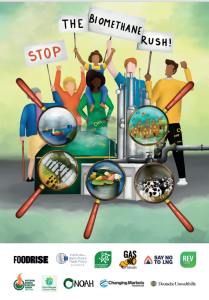
Check out our biomethane booklet!
A coalition that reveals the cross-sector risks of the biomethane scale-up
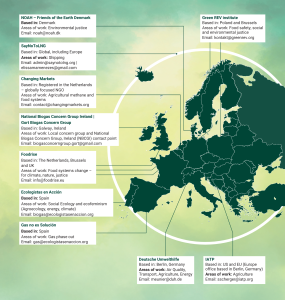
We are a group of independent not-for-profit organisations that have come together to ensure that the environmental, community, and climate risks of the massive upscaling of biomethane are heard by decision makers.
Our StopTheBiomethaneRush coalition represents a broad range of organisations active in the fields of food sovereignty, sustainable land use, animal rights, energy systems, shipping, the heating transition, and emissions mitigation. Significantly, local communities around Europe are also represented in our coalition, giving voice to the people directly affected on the ground.
Together, we challenge the large-scale development of industrial biogas operations that creates risks of additional environmental pollution, climate impacts, and social injustices.
While we recognise that biomethane from unavoidable organic waste streams can contribute to energy needs, levels produced must be kept within a sustainable niche.

-
Biogas is produced by breaking down organic materials in the absence of oxygen in a process called anaerobic digestion. The organic materials used for production (feedstocks) include: crops specially grown for this purpose, most often maize; food and plants considered waste; sewage sludge; industrial wastewater; as well as animal manure. Gas from landfills can also be collected. Biogas can be used directly for heating and electricity generation. Biomethane is biogas that has been purified to increase the methane concentration, making it similar to fossil gas. Once upgraded, biomethane can be injected into the gas grid and used in systems that run on fossil gas.
-
The European Commission’s REPowerEU action plan of May 2022 set biomethane production on a course of massive upscale as part of efforts to increase EU energy independence, fixing a target of 35 billion cubic meters (bcm) per year by 2030 – up from 4,1 bcm in 2023. However, no Impact Assessment was carried out on the target. As biomethane production continues to grow rapidly (with a currently 21% year over-year growth), so do concerns about its associated environmental and social risks – be it the effects of large-scale biogas production on the use of limited agricultural land, the continuation of polluting industrial animal production, harm to local communities, and the effects of methane leaking from biogas facilities. Further concerns arise when looking closer at promoted use cases for biomethane such as heating or transport which are often inefficient, expensive, and lock Europe into fossil infrastructure.
-
The expansion of profit-driven industrial-scale anaerobic digestion projects, largely driven by multinational agribusinesses, is transforming rural landscapes across the EU. Such operations utilise diverse feedstocks, sourced from extensive areas, placing heavy demands on local infrastructure, increasing traffic from heavy vehicles, and disrupting rural economies and tourism. EU policy must ensure that biomethane development aligns with local needs and capacities.
-
To be economically viable, industrial biogas plants require a constant supply of crops and manure. This has caused monoculture production of energy crops, harming biodiversity and taking land away from sustainably growing food to eat or other materials needed to move away from a fossil-fuel economy. Worse still, industrial biogas may incentivise more and larger factory farms, or at least lock in current production levels, even though there is an urgent need to reduce the production and consumption of animal products in order to achieve climate targets. Ultimately, even though biogas production is marketed as a climate fix, its approach to reducing animal emissions – two thirds of the EU’s agricultural emissions – is simplistic and narrow, ignoring the broader scope of emissions connected to industrial animal production.
-
The promotion of biomethane from animal manure dangerously legitimises and entrenches industrial animal agriculture. Rather than addressing the root cause of environmental destruction – our over reliance on animal-based food systems – biomethane provides a false solution that props up a harmful status quo. Industrial farming is inherently exploitative, subjecting animals to systematic confinement, mutilation, and premature death. By monetising manure through biomethane, we create subversive incentives to sustain or even expand these systems under the guise of sustainability.
-
In early 2025, the EU agreed to introduce the first-ever binding food waste reduction targets for its member states, to be achieved by 2030 – a historic decision. Why? Because in 2022, the EU still wasted between 59 and 144 million tonnes of food per year, including food wasted at farm level. That could well be equivalent to about three quarters of the food the EU imports! But food waste isn’t inevitable — it’s a result of business decisions in the food value chain, especially by powerful players like supermarkets.Yet, to meet the EU’s 35 bcm biomethane production ambition, food waste volumes will need to remain similar to current levels. This creates a perverse incentive: instead of preventing waste, the system locks in reliance on a steady flow of it, directly undermining efforts aimed at reducing food waste at its source.
-
Biomethane has an angle on energy use that cannot be ignored, even though European targets give it a greater role than we consider achievable within its sustainability niche. However, in no way will biomethane be able to replace all the current uses of fossil gas and in the new sectors in which it is announced to be developed, such as maritime transport. Priority should therefore be given to local production and the direct use of biogas in locations close to its production, favouring the emergence of synergies with related industries, which are necessary for the ecosocial transition, use high temperatures, and have no other option for decarbonisation. Its use should also be prioritised for self consumption in the production plants themselves.
-
The push to use biomethane (also called bio LNG) in shipping is a dangerous diversion from real climate action. Much like fossil LNG, biomethane use in marine engines results in methane slip, releasing unburned methane—an extremely potent greenhouse gas, over 80 times more powerful than CO2 in the short term. Lifecycle emissions studies reveal that biomethane can have a higher climate impact than conventional fuels like marine gas oil, especially when upstream leakage and methane slip are accounted for. By investing in biomethane, the shipping industry also perpetuates reliance on fossil LNG terminals and engine technologies. The result is a costly detour — biomethane delays the urgent transition needed towards scalable, zero-emissions shipping solutions.
-
The idea that so-called “decarbonised gases” such as biomethane can replace Russian gas and fossil gas more generally in heating systems is flawed. Firstly, the limited sustainable potential of biomethane production makes it insufficient to meet the extensive demands of the heating sector and is in direct competition with the use in hard-to-abate sectors. Secondly, using biomethane in heating systems other than local small district heating grids, would result in minimal shares blended in the grids, would constitute a mere alibi to continued use of fossil gas beyond 2040, and is up to 7 times less efficient than electrification options. Thirdly, the continued use of gaseous fuels would result in continued domestic casualties in the EU, which are taking a serious toll across the whole EU due to accidents and carbon monoxide poisoning.
-
Methane emissions from biogas and biomethane are a serious and growing climate, health, and environmental liability. Methane warms the planet over 80 times more than CO2 over a 20-year period. Methane also acts as a precursor of air pollution, specifically to ground-level ozone, which poses severe health risks, including respiratory problems and aggravation of asthma. Such ground-level ozone also affects ecosystems and the economy by harming sensitive species, and damaging crop harvests. Methane mitigation in this sector is a low hanging fruit: technical solutions are available, cost-effective, and even in the financial interest of plant operators themselves.
-
See our recommended further reading here.
Feel free to reach out!