
Questions or ideas?
We would love to hear from you!
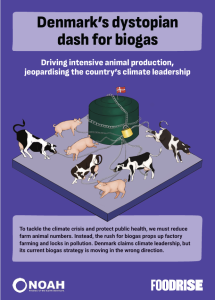
Our new research together with NOAH-Friends of the Earth Denmark, reveals a concerning development: the expansion of manure-fed biogas risks undermining Denmark’s climate ambitions. Analysis of Danish biogas and livestock data shows that, despite an overall reduction trend, municipalities with the largest biogas production capacity have also experienced the greatest increases in pig or cattle numbers over the past 15 years. The four municipalities with the highest biomethane and electricity production saw an estimated 8% increase in pig numbers, while those ranked 5–8 saw a 5% increase in cattle between 2010 and 2024.
That the hype around biomethane is real is also reflected in the European Commission’s ambition to reach 35 billion cubic metres (bcm) per year by 2030. This trend comes at a time when scientists repeatedly stress the need to reduce livestock numbers to meet climate targets. Animal agriculture accounts for an estimated 84% of EU agricultural emissions, and around 80% in Denmark. While the industry promotes biogas as a solution to methane emissions, manure represents only about one-quarter of total emissions from animal production. This narrative overlooks emissions from enteric fermentation (such as methane from ruminant digestion), which account for nearly 40%, as well as emissions from feed production, responsible for around 30%.
Despite these limitations, funding priorities tell a different story: an estimated 20 times more public funding is allocated to biogas than to the Plant-Based Food Grant under Denmark’s Plant-Based Action Plan.
The data also highlights a broader trend of intensification in livestock farming. While the number of pig farms has dropped from over 5,000 in 2010 to fewer than 2,000 in 2024 (a reduction of more than 60%), the average number of pigs per farm has more than doubled, from 2,600 to nearly 6,000.
This points to a key structural issue: scaling up biogas requires large volumes of manure. The industry aims to collect significantly more manure than the government predicts, relying on unrealistically high collection rates of around 75% of the total manure produced. Under more realistic assumptions, meeting these targets would require a substantial increase in livestock numbers—resulting in higher emissions and greater environmental pressure. The benefits of biogas expansion therefore appear to favour mostly large-scale industrial farms, with the potential to lock us into an industrial food system that affects animals, people, and the planet.
Read the full briefing here:

We would love to hear from you!
Share on social media
Stay up to date with our latest work.