
Questions or ideas?
We would love to hear from you!
“This could be the moment of change” were the words David Attenborough used when referring to the United Nations Third Ocean Conference in Nice that took place in early June. As world leaders poured into Nice to discuss ocean protection, journalists and policy makers alike were speculating on the big wins we would see from the conference. Here at Foodrise, our critical eye was trained on the conversations taking place around industrial fish farming. Would world leaders highlight the unsustainable practices of this industry? Would the communities affected by this industry get the airtime they need and deserve?
Murky waters: The uncritical embrace of industrial fish farming
There was a lot to be celebrated at UNOC, yet when it came to fish farming we were disappointed by the framing of industrial aquaculture as the future of the ‘blue economy’. Globally we now eat more farmed fish than wild-caught fish. But where was the debate on the subject? Key international and regional bodies such as the UN’s Food and Agriculture Organisation (FAO) and European Commission are turning a blind eye to the voices of communities whose traditional relationships with their coasts and fish are being disrupted.

At one event, Türkiye’s deputy minister for Agriculture Ebubekir Gizligider’s celebration of aquaculture’s growth was perhaps unsurprising given the country’s aquaculture sector has doubled in the last ten years. An investigation by journalists at Desmog recently highlighted how Türkiye now supplies more than half of the world’s seabass and a third of its seabream. But at the same time, anchovy stocks in the Black sea have been decimated and the country now increasingly sources fish oil from West Africa, itself a region where sardinella stocks are now at their lowest ever recorded. According to calculations by Desmog, the amount of fishmeal extracted across four years by Kılıç Deniz, the biggest Turkish importer of Senegalese fish oil, would have been enough to feed two million people. The seabass farmed by Kilic, using extracted Senegalese fishmeal, is further shown to be sold across several major UK retailers including Waitrose, Co-op, Aldi, Lidl and Asda.
Communities cut through the blues
An undercurrent of hope existed in the voices of communities leading the charge when it came to holding industry and government to account. At an event co-hosted by the Coalition for Fair Fisheries Arrangements, the African Confederation of Professional Organisations of Artisanal Fisheries (CAOPA), Low Impact Fishers of Europe, and Blue Ventures, speakers from Senegal, Chile, France and India issued a powerful call for their voices to be heard and taken into account in policy making. Small-scale fishers have a central role to play in ocean management. As communities with daily contact with the sea, they are the groups who best understand the changes in the ocean and the difficulties faced by populations reliant on fishing.
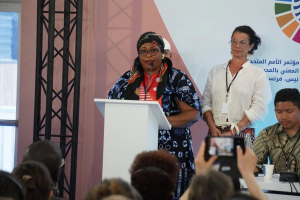
Rise Up’s ‘Ocean Basecamp’ also provided an open space to present more local and regional evidence of the plight of the ocean. We met organisations like the Bob Brown Foundation (Tasmania) and Mujeres por la Defensa del Mar, a group of coastal Chilean indigenous women also fighting the growth of salmon farms. The event spaces here were buzzing and allowed us to speak, exchange and plan with some inspiring activists and campaigners.
Making waves: Foodrise and Greenpeace’s Ocean Takeover launch event
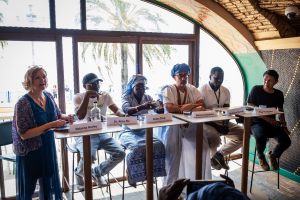
The highlight of our week for us was the launch of our new ‘Ocean Takeover’ report in partnership with Greenpeace at a media briefing attended by journalists from around the world. We brought together four powerful speakers:
In the room we also had Fay Orfanidou, leader of a Greek campaigning group called Aktaia, which is challenging the rapid growth of seabass farming around their island of Poros.
In Greece seabass and seabream farming has seen a 141% increase since the turn of the century. At the same time, it pollutes local waterways and coastlines, damages marine ecosystems and upends economic activities in tourism.
In West Africa, fish is being converted into fish meal and fish oil to feed the growth of fish farms, just like the farms on Fay’s home island of Poros. Globally, if we ate the wild fish (herring, sardine, anchovy, mackerel and blue whiting) currently reduced down to fish oil and fed to farmed seabass and seabream directly, over 300,000 tonnes of fish could be left in the ocean for ecosystem health and restoration. Yet if we focus just on West and Southern Africa, using conservative assumptions, nearly one million people in these regions could eat a weekly portion of 200g of fish, instead of the fish being turned into fish oil. Mansour, Mustapha and Diaba all spoke in great detail of the impact of the expansion of fish meal and fish oil trawlers and factories in their local communities. It was truly moving to then have the different communities come together and call for much needed change!
Call to Action: Let Our Oceans Breathe!
The growth of industrial fish farming is suffocating the coasts of Greece and emptying the coastline off West Africa. In the wake of UNOC we will be channelling this energy into our campaign work, reflecting on Diaba’s closing call to action:
In Wolof we say – To Protect the Oceans, is to Protect Ourselves – Without the Ocean we cannot live’
It is time. We are rising, we are demanding that we are taken into account, that we let our oceans breathe!


We would love to hear from you!
Share on social media
Stay up to date with our latest work.